
Introduction: You Can See the Future First in Hangzhou
"How did you go bankrupt?" "Two ways. Gradually, then suddenly." — Hemingway, The Sun Also Rises (1926)
For three years the people with situational awareness were in San Francisco, counting OOMs. The frontier would belong to whoever could spend the most: bigger clusters, bigger training runs, a trillion-dollar buildout. That story is not wrong. It is just no longer where the action is.
The action is in the price of a token.
Look at the trendlines. The cost of a fixed unit of intelligence has fallen roughly 10x per year since GPT-3, faster than compute fell during the PC era or bandwidth during the dotcom boom. The best open-weight model now trails the best closed model by about four months, and the open frontier is moving faster: its measured capability doubles every 3.9 months, against 5.5 for the closed frontier. Each additional 10x of pretraining compute now buys a few points on a hard benchmark, and the 10x after that will buy fewer. And the compute itself has become something you rent by the hour from more than two hundred "neoclouds."
Put those four lines on one chart and you get the picture the frontier labs would rather you not see: intelligence is becoming a commodity, and the moat was never the model.
The incumbents know this. You can tell by how they are behaving. In February, OpenAI sent Congress a memo accusing DeepSeek of free-riding on American models. Anthropic followed with a report that three Chinese labs had pulled sixteen million exchanges out of Claude to train their own. Both argued the remedy was tighter export controls. On Sunday, Elon Musk, in the same post announcing that SpaceX had closed $40 billion of debt to buy GPUs for itself, predicted "guppy-level death" for the neoclouds. The people with the most to lose from cheap intelligence are telling you that cheap intelligence is dangerous, unfair, and doomed. That is the tell.
Here is the thesis in one page:
- Price, not capability, is the binding constraint on AI adoption. The capability already exists. What changes behavior is the price falling below the threshold where using the model is cheaper than not using it. Those thresholds are being crossed monthly.
- The open frontier has caught the closed frontier to within a product cycle. Four months is less time than it takes a large enterprise to finish a procurement.
- Hangzhou proved that constraint breeds efficiency. Export controls forced Chinese labs to get more out of less. They published the recipes. The recipes are now everyone's.
- Scaling is hitting diminishing returns at exactly the moment it got expensive. A training run that costs billions and buys a few benchmark points is not a moat. It is a liability.
- Neoclouds are the commodity layer. The shakeout Musk predicts is real, and it is what every commodity market looks like on its way to maturity. Railroads consolidated. The trains kept running.
The future of AI is not three companies with one trillion-dollar model each. It is tens of thousands of cheap, specialized, custom-built models, distilled, fine-tuned, and run on rented GPUs, most of them descended from weights that cost nothing to download.
What follows is that case, made as its strongest defenders would make it. Section VII is the strongest case against it.
I. Counting the Dollars
The price of a fixed unit of intelligence has fallen roughly 10x a year since GPT-3. The open frontier is about four months behind the closed frontier and compounding faster. Open models already carry a third of real-world usage and collect four percent of the revenue. That ratio is what a commodity looks like on its way in.
The frontier labs count OOMs of compute. A buyer counts dollars per unit of capability. Here is that count.
The 10x-a-year line. When GPT-3 opened to the public in November 2021, a model scoring in the low 40s on MMLU cost $60 per million tokens. Three years later the cheapest model clearing the same bar cost six cents: a 1,000x decline, faster than compute fell during the PC era or bandwidth during the dotcom boom (a16z, "LLMflation"). Epoch AI measured the same slope across six benchmarks and found the price of reaching a given milestone falling anywhere from 9x to 900x per year, with GPT-4's score on PhD-level science questions getting 40x cheaper annually (Epoch AI). A 2026 economic analysis of the token market puts the total decline at roughly 600-fold in under six years and finds a structural break in the series: the decline accelerated once cross-border price competition began (arXiv:2603.28576).
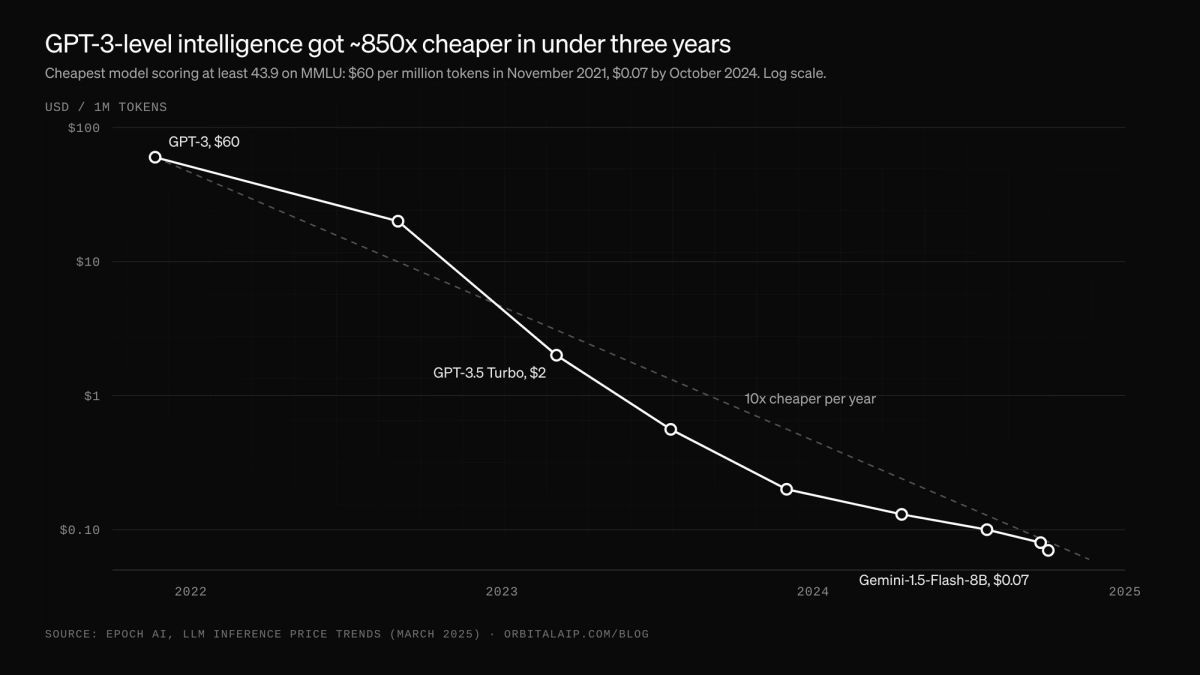
From sixty dollars to seven cents. The dotted line is what a clean 10x-a-year decline looks like; the data hugs it, and the steepest drops arrive with open-weight releases.
2026: the line keeps going. Silicon Data's usage-weighted token index fell from $2.04 per million tokens on May 31 to about $1.17 in early August and a record $0.97 on September 1, less than half its summer peak (Silicon UK; KuCoin). Jefferies attributed the drop to two forces at once: cheap Chinese open-weight releases, and American labs cutting to match. OpenAI cut GPT-5.6 prices by up to 80 percent. Anthropic shipped Opus 5 at half the price of its Fable 5 flagship with comparable performance. DeepSeek's V4-Flash, at three cents per benchmark task, was the most-used model in Jefferies' tally that week, serving 8.2 trillion tokens, with Tencent's Hy3 second at 7.1 trillion.
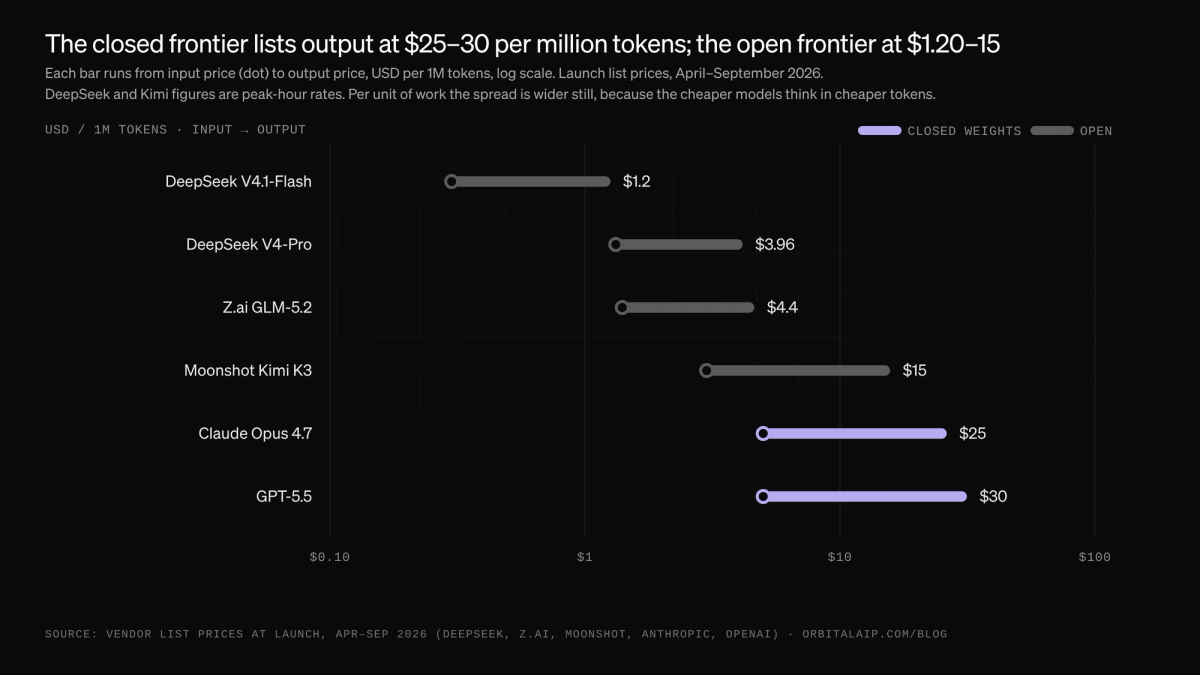
The bars are the sticker prices. Per unit of work the spread is wider still, because the cheaper models think in cheaper tokens: Artificial Analysis puts DeepSeek V4-Pro at about six cents per Intelligence Index task against $2.34 for Claude Opus 5.
Per unit of work, the gap is not 2x. It is 40x. On Artificial Analysis's Intelligence Index, DeepSeek V4-Pro scores 53 against 63 for Claude Opus 5 at the top of the board. It costs about $0.06 per completed benchmark task against $2.34 for Opus (Forbes). Eighty-four percent of the capability for two and a half percent of the price. Nobody pays for the last sixteen percent unless the task demands it, and most tasks do not.
Four months. Epoch AI puts the lag between the best open-weight model and the closed state of the art at about four months (Epoch AI, May 2026). Mozilla's September update, using METR's methodology, says 4.4 months, and adds the part that matters: open capability is doubling every 3.9 months against 5.5 for closed (Mozilla report, summarized). The UK's AI Security Institute, measuring cyber capability specifically, found the gap narrowed from 6 to 10 months through 2025 to 4 to 7 months in 2026 (UK AISI). The faster line is four months behind the slower line. You do not need a PhD to extend that.
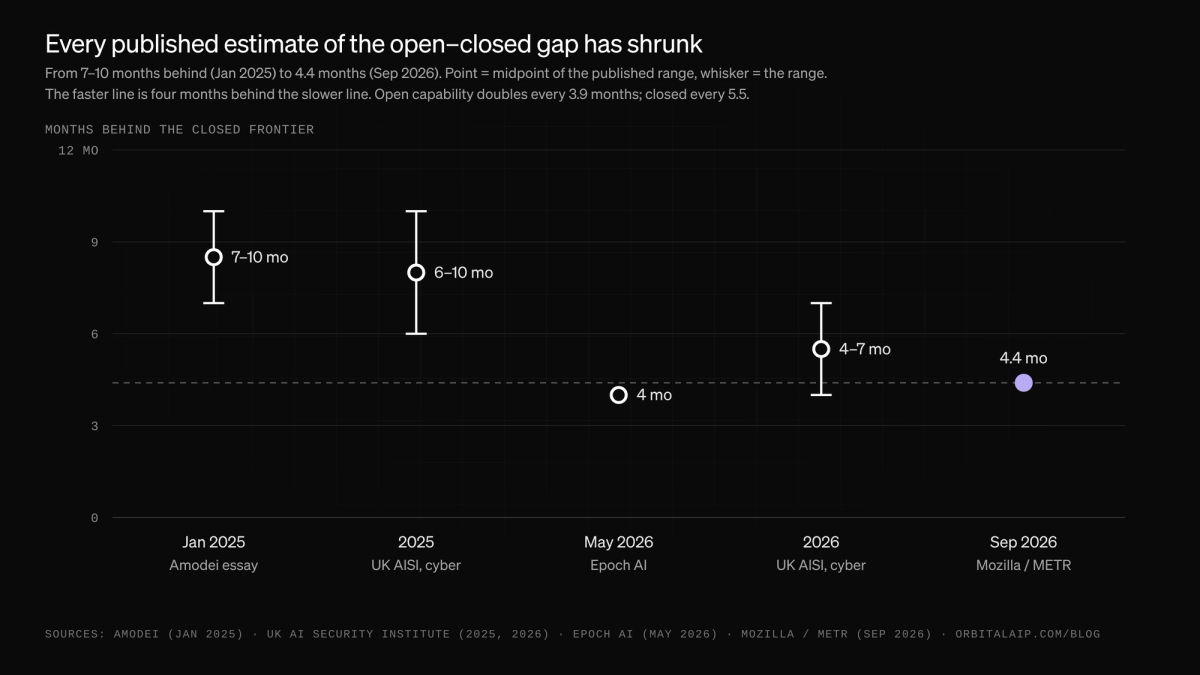
Five estimates, four methods, one direction. The 2025 figures were measured against DeepSeek V3 and the first R1-era models; the 2026 figures against GLM-5.2, DeepSeek V4-Pro and Kimi K3.
Distillation is the great leveler. Every frontier model becomes a teacher the moment it has an API. The expensive thing a frontier lab makes, the reasoning behavior and the post-training, leaks out one completion at a time at retail token prices. Anthropic says three Chinese labs ran more than sixteen million exchanges through Claude to capture exactly that (TechCrunch). OpenAI told Congress that DeepSeek wrote code to pull its outputs programmatically through obfuscated routers (Rest of World). Set aside whether it was fair. Ask whether it can be stopped. You cannot export-control a text completion. A billion-dollar training run becomes a few-million-dollar fine-tuning dataset within a quarter, and the student ships with open weights.
Usage follows price. Revenue has not caught up. Open weights serve roughly a third of tokens routed through OpenRouter, and the five highest-volume models there are all open (Mozilla, State of Open Source AI 2026). By Mozilla's count, open models carry a third of real-world usage and collect about four percent of global AI revenue (Northeast Times). Read that the way a frontier lab reads it: a third of demand has already left the premium tier. Then read it the way a buyer reads it: the premium tier is collecting about twelve times the revenue per unit of usage on the remaining two-thirds.
II. What Hangzhou Built With Less
With export-controlled chips, a fraction of the frontier's capital, and a state that treats open weights as foreign policy, Chinese labs shipped models four months behind the frontier, published the weights, and by August were serving more requests than anyone on the world's largest model router. The constraint was not the obstacle. The constraint was the method.
Let me give you the numbers, and then the honest accounting, because both matter.
The headline. In December 2024 DeepSeek released V3 and reported that its final training run cost $5.576 million across 2.788 million GPU-hours on H800s, a chip Nvidia designed to comply with American export controls (DeepSeek V4 architecture guide). Five weeks later R1 matched the first American reasoning models and shipped with open weights. On January 27, 2025, Nvidia fell 17 percent and lost $589 billion of market value in a single session, the largest one-day loss in stock-market history at the time (Forbes).
The honest accounting. The $6 million covered only the final run. SemiAnalysis reported that DeepSeek operated roughly 50,000 Hopper GPUs and had spent about $1.6 billion on servers (Forbes). Anthropic's CEO wrote that V3 was an expected point on the cost-reduction curve, roughly 8x cheaper than American models a year older, and that DeepSeek's total spend as a company was not vastly different from the US labs' (Dario Amodei, "On DeepSeek and Export Controls"). Fine. Take the frontier's own generous reading. It still says this: a lab in Hangzhou, on chips deliberately hobbled by the US government, produced a near-frontier model at a fraction of the frontier's unit cost, and then published the recipe: latent attention to shrink the memory cache, fine-grained mixture-of-experts so a 671-billion-parameter model fires 37 billion per token, FP8 training, hand-tuned communication kernels to route around the H800's crippled interconnect. The export controls did not prevent the result. They shaped it, and the shape turned out to be exactly what a cost-constrained world needed.
Eighteen months later: the cadence. Four frontier-class open-weight models shipped from China in the first half of 2026 alone (Second Talent).
- DeepSeek V4 (April 24): V4-Pro at 1.6 trillion parameters, 49 billion active; V4-Flash at 284 billion, 13 billion active; both with a million tokens of context, both pre-trained on more than 32 trillion tokens, both MIT-licensed, and reportedly trained on Huawei Ascend and Cambricon accelerators rather than Nvidia parts (DataCamp; Second Talent). The price history since is the whole thesis in miniature: Pro launched at $1.74 per million input tokens, was cut to 44 cents in May, was raised to $1.32 in August when the production model shipped, and in September DeepSeek routed all Pro traffic to the new V4.1-Flash at 30 cents, because the cheaper model had overtaken the flagship on agent benchmarks (Coursiv; Forbes). A lab that parks its own flagship behind its budget model is not afraid of commoditization. It is the commoditizer.
- Moonshot's Kimi: K2.6 (April 20) tied GPT-5.5 on SWE-Bench Pro at roughly 80 percent lower cost; K2.7-Code (June 12) was the fifth major release in under a year (Data Gravity). K3 (API July 16, weights July 27) is a 2.8-trillion-parameter model with 104 billion active, published as 1.56 terabytes of shards, the largest open release ever made (Second Talent). It debuted first on LMArena's Frontend Code Arena and scores 88.3 against GPT-5.6 Sol's 88.8 on Terminal-Bench 2.1; Mozilla's September tally puts the best open model two points behind Fable 5 on the Artificial Analysis index at 30 percent of the list price (Mozilla). Demand was heavy enough that Moonshot paused new subscriptions on July 20.
- Z.ai's GLM-5.2 (June 13): 753 billion parameters, about 40 billion active, MIT-licensed, million-token context, the top open-weight model on the Artificial Analysis index at release, and 62.1 on SWE-bench Pro against GPT-5.5's 58.6 (Second Talent). Its predecessor GLM-5 was trained on a 100,000-chip Huawei Ascend cluster. The UK's AI Security Institute found GLM-5.2 the most cyber-capable open model it had tested, reaching the level of Claude Opus 4.5 less than seven months after that model shipped (UK AISI).
- Alibaba's Qwen: more than a billion cumulative downloads on Hugging Face, over 200,000 Qwen-tagged models, roughly 40 percent of all new LLM derivatives on the Hub (Data Gravity). The Apache-licensed Qwen3.6-35B-A3B runs on a 24GB laptop and scored 73.4 on SWE-bench Verified with three billion active parameters (Second Talent). Alibaba priced its 2.4-trillion-parameter flagship at $2 per million input tokens, below the mid-tier products from OpenAI and Anthropic, because for Alibaba the model is a funnel for cloud (Forbes).
- Behind them: MiniMax M3 (June 1; 427 billion parameters; 80.5 on SWE-bench Verified), Xiaomi's MiMo, Tencent's Hunyuan, StepFun. In July the top four Chinese open models sat at 80.6, 80.5, 80.2 and 77.8 on SWE-bench Verified (Second Talent). That benchmark is saturated. For open weights.
Where the tokens go. By May 2026, Chinese open-weight models were carrying between 46 and 61 percent of all tokens routed through OpenRouter, depending on how you count. Xiaomi's MiMo alone took about 21 percent, DeepSeek's 17.6 percent outranked every American lab, Google's share had collapsed from 37 to 13 percent, and Meta's Llama had fallen below one percent (Data Gravity; Mozilla). In August, for the first time, an open model led the router on weekly requests: DeepSeek took the top spot on August 3 after Google had held it for 51 weeks. Eight of the ten highest-volume models were open weights, seven of them Chinese. DeepSeek counts more than 26,000 enterprise accounts (Mozilla). On Vercel, DeepSeek's share of tokens rose from under one percent to 17 percent while its share of revenue stayed near one (Data Gravity). Nobody routes production traffic to Hangzhou out of ideology.
This is policy, not accident. The State Council's AI-Plus directive (August 2025) and the Fifteenth Five-Year Plan (March 2026) name open-source proliferation as a state objective. In July China launched a World AI Cooperation Organization in Shanghai with 29 founding states, 37 by month's end, and pledged 5,000 training slots to developing countries (Mozilla). The mechanism is elegant. Release the weights and inference moves onto the end user's own hardware: no serving cost, no export surface, no chokepoint to sanction. Washington spent three years building a chip blockade. Beijing's answer was to make the chips matter less by making the models free.
The capital, for the record. DeepSeek has raised about $7.4 billion and is seeking roughly $8 billion more at a $74 billion valuation ahead of a Shanghai listing. Moonshot has raised $7.3 billion. Zhipu and MiniMax are public in Hong Kong, and the four pure-play labs are worth about $160 billion combined (Mozilla; Forbes; Data Gravity). That is real money. It is also a fraction of what the leading American labs have raised, it was spent under tighter constraints, and it bought a position four months behind the frontier with a cost structure the frontier cannot match.
III. Racing to the Rentable Cluster
Compute became something you rent. More than two hundred neoclouds sell GPU-hours by the contract, the hyperscalers are their largest customers, and a frontier lab pays a rocket company $1.25 billion a month for capacity it does not own. This week's rout is a credit crunch in a commodity market. Commodity markets have those. They do not stop being markets.
The trillion-dollar cluster was supposed to be the moat: whoever owned the most compute would own the frontier. Here is what actually happened to compute.
It became a product. A neocloud is a company whose entire business is buying GPUs and renting them out. CoreWeave, the largest, reported second-quarter revenue of $2.575 billion, up from $1.212 billion a year earlier, and a revenue backlog of $104 billion, up 246 percent, before counting more than $25 billion of new commitments signed in early Q3 (CoreWeave Q2 2026 8-K; DCD). It has 4.2 gigawatts under contract and is targeting eight by 2030. That backlog was $9.9 billion at the end of 2023 (CoreWeave investor presentation). Ten-x in two and a half years. Nebius grew revenue 454 percent year over year to $582 million in the same quarter, closed four contracts of more than $1 billion each, expects five gigawatts under contract by year-end, and saw its production inference workloads triple in three months. Those are the trendlines of a commodity being born.
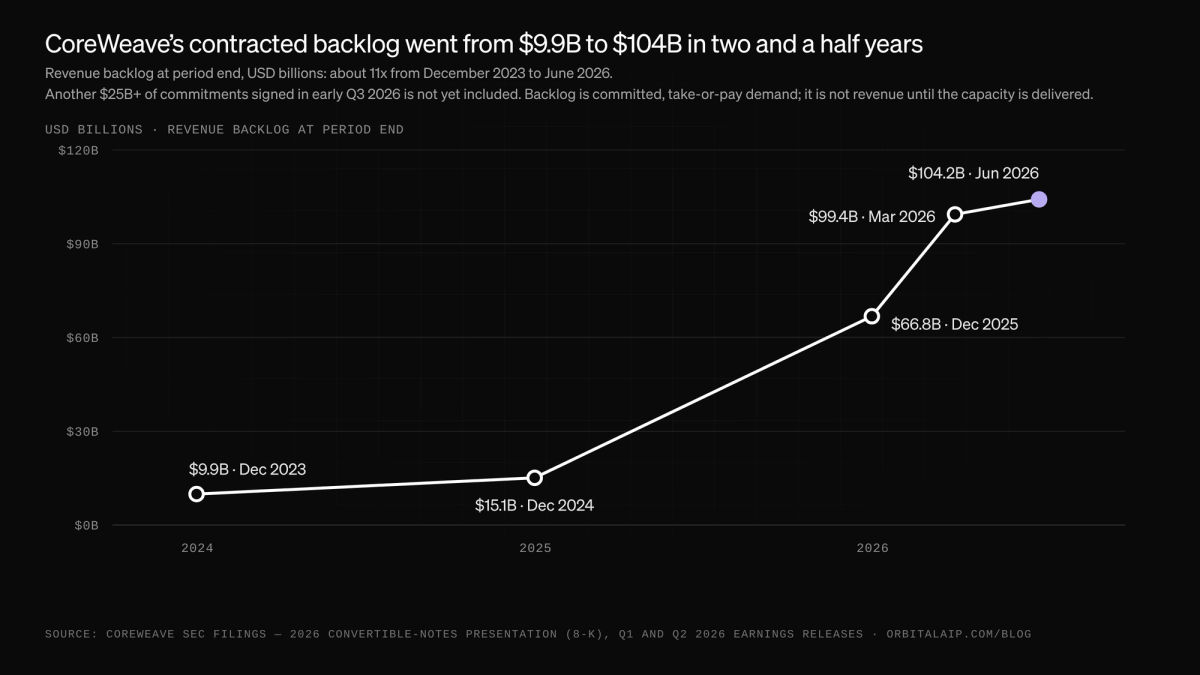
Backlog is committed, take-or-pay demand from named customers; it is not revenue until the capacity is delivered, which is the risk Section VII returns to.
The hyperscalers are the customers. This is the part the trillion-dollar-cluster story missed. Microsoft has committed more than $60 billion to neoclouds: $23 billion to Nscale for 200,000 GB300s, up to $19.4 billion to Nebius, $9.7 billion to IREN, plus CoreWeave and Lambda (Introl; Data Center Knowledge). Google rents CoreWeave capacity for its OpenAI work. Meta signed a $14 billion CoreWeave deal. The companies that supposedly needed to own everything discovered that someone who had already solved power, permits and chips could sell it faster than they could build it. CoreWeave's customer list reads Meta, Microsoft, OpenAI, Anthropic (Motley Fool).
The frontier labs rent too. In May, Anthropic signed for all of Colossus 1, the 220,000-GPU, 300-megawatt Memphis cluster that Musk's xAI built, and SpaceX's own SEC filing put the price at $1.25 billion a month through May 2029, more than $40 billion in all, cancellable by either side on 90 days' notice (TechCrunch; Capacity). The same filing says SpaceX expects to sign more such agreements (Gigazine). Anthropic's compute stack now spans Amazon (up to 5 gigawatts), Google and Broadcom (5 gigawatts in 2027), a $30 billion Azure arrangement with Microsoft and Nvidia, $50 billion with Fluidstack, and a direct competitor's data center (CoinDesk). When the frontier rents from a rival at $15 billion a year, compute is not a moat. It is a utility bill.
This week. CoreWeave, Nebius and IREN each lost more than 30 percent in October. Credit-default swaps on Meta, Oracle and Nvidia debt hit record spreads. Meta turned cash-flow negative. SK Hynix pulled the Solidigm IPO (CNBC). Firmus aborted an IPO at a $30 billion valuation, Nscale is getting pushback on the same number, and Elice fell 30 percent on its first day in Seoul (Daily Upside). Gartner says 80 percent of neoclouds will cease operations or be absorbed by 2030. Nvidia, which has become the sector's financier, signed as tenant on $20 billion of future data-center leases it intends to assign to others (CNBC). CoreWeave carries $35.6 billion of debt principal, with repayments spiking to $14.9 billion in 2031 (Fierce Network). And on Sunday Musk predicted guppy-level death for the two hundred.
Read it as a commodity market. Every commodity layer in the history of infrastructure has had this week. In the 1990s the fiber overbuild bankrupted Global Crossing and WorldCom; the fiber did not go dark. It was bought out of bankruptcy for cents on the dollar and lit by others, and that is why bandwidth got cheap enough to build the web on. Railroads consolidated from hundreds to a handful; the trains kept running and freight got cheaper. A neocloud shakeout does not raise the price of compute. It lowers it: stranded GPUs get sold at a discount to whoever is left, and the survivors' cost basis drops. The frontier labs, now the neoclouds' largest tenants, should know this better than anyone. Gartner's 80 percent is not a prophecy of scarcity. It is a prophecy of consolidation in a layer that has already proven it can deliver $100 billion of contracted demand.
What the shakeout leaves behind is exactly what the custom-model future needs: a deep, liquid, boring market for GPU-hours, where old chips still earn (CoreWeave just signed an A100 contract, on a part from 2020, that runs into 2029 (DCD)), new chips are priced by competition, and a managed layer above it, Together, Fireworks, Baseten, Nebius's Token Factory, lets anyone with a dataset fine-tune an open model without owning a rack. That is where the next ten thousand models get trained. Not in a trillion-dollar cluster. In a rented one.
IV. The Fear at the Frontier
Every move the incumbents have made this year, the post, the memos, the advisories, the letter they would not sign, is the move of a party that has read Sections I through III and believed them. The reaction is the evidence.
The post. On Sunday afternoon, Elon Musk announced on X that SpaceX had closed $40 billion of debt, mostly callable, to buy GPUs arriving in the first half of 2027, and said that debt markets had in recent weeks nearly shut off money to any company without substantial revenue outside AI data centers. SpaceX, he noted, is investment grade and has Starlink and launch revenue. Then the line that moved the stocks: the 200-plus neoclouds would see "guppy-level death and consolidation" (CoinDesk; FourWeekMBA). He was replying to Chamath Palihapitiya, who had called the neoclouds disorganized and poorly capitalized and predicted stranded, half-built capacity in 2027. Asked whether he was talking the stocks down ahead of a buyout, Musk said SpaceX was not buying any neoclouds and called the idea pointless. CoreWeave, Nebius and IREN fell further in overnight trading (Stocktwits).
Now consider who is speaking. SpaceX is a neocloud. In May it rented all of Colossus 1 to Anthropic at $1.25 billion a month, and its S-1 says the company expects to sign more such contracts and describes a strategy of running its own models on its data centers while leasing out the surplus (TechCrunch). TechCrunch's reading at the time was that xAI had overbuilt as Grok usage fell and needed a tenant before the IPO. In July, Musk endorsed Jensen Huang's open-weights letter, writing that Huang was right (Dealroom). So on Sunday the best-capitalized GPU landlord in the world, fresh from borrowing $40 billion to buy more GPUs, told the market that two hundred smaller landlords would die, that he would not be buying them, and that the credit window had closed behind him. Every word of it may be true. The credit stress is real, CNBC documented it the same week, and Palihapitiya may well be right about 2027. But read the post for its structure. It is not a warning about a bubble. It is a landlord describing the terms on which he expects to inherit a market. Call it fear-mongering if you like; the more precise word is positioning. If lenders believe the two hundred are doomed, the two hundred cannot refinance, their contracts reprice, and the capacity ends up with whoever can still borrow. He told you who that is in his first sentence.
The memos. The frontier labs' year reads the same way, one layer up.
- January 2025. Within days of R1, the White House AI adviser said there was substantial evidence DeepSeek had distilled OpenAI's models, and OpenAI and Microsoft opened an investigation (Gov Info Security). Anthropic's CEO published an essay arguing that DeepSeek's releases made chip export controls "even more existentially important" (Dario Amodei).
- February 2026. OpenAI sent the House Select Committee on the CCP a memo describing DeepSeek's next model as part of an effort to free-ride on American labs, alleging that DeepSeek employees had used obfuscated routers to pull outputs for distillation, and warning that some Chinese developers were cutting corners on safety (Rest of World). Two weeks later Anthropic reported that DeepSeek, Moonshot and MiniMax had run more than sixteen million exchanges through Claude via fraudulent accounts, and drew the policy conclusion in one line: distillation attacks "reinforce the rationale for export controls" (TechCrunch).
- June 12. The Commerce Department ordered access to Fable 5 and Mythos 5 suspended under export controls. The models went dark for everyone for nineteen days (Anthropic).
- July 16 to 27. Kimi K3 shipped, API first, weights eleven days later. The Treasury Secretary floated sanctions. The White House science adviser accused Moonshot of distilling Fable. A bipartisan bill appeared. On July 24 Jensen Huang made his first post on X to publish a letter signed by Nvidia, Microsoft, Meta, Mistral, IBM, Palantir and Hugging Face asking Washington not to restrict open weights. OpenAI and Anthropic did not sign (Fortune). Three days later Anthropic published its own position on open weights, and K3's weights went public. No recall is possible (Mozilla).
- August to September. The White House exempted open weights, American and Chinese, from pre-release testing. An NSA, CISA and FBI advisory asserted that K3 had been distilled from Fable and told US providers to degrade suspected distiller accounts. Anthropic's next report named six labs and counted 151 million exchanges by Alibaba and 23 million by Moonshot, with Opus as the target (Mozilla). Neither the advisory nor the report has published its underlying evidence; Mozilla's tracker marks every line as alleged.
What the pattern says. Here is how the defenders of cheap, open AI read that year.
- A complaint about distillation is a confession about the moat. If the most valuable thing a frontier lab makes can be extracted through its own retail API, one completion at a time, at list price, then the moat is the price of tokens, and the price of tokens falls 10x a year. Every incumbent whose product became a commodity went to the government first. That is not evidence of bad faith. It is evidence of a commodity.
- The remedy sought raises rivals' costs rather than lowering one's own. Chips first, then API access, then model outputs, then, by the summer's bill, the weights themselves. The frontier's own CEO wrote in January 2025 that DeepSeek's cost reductions were on trend. If they are on trend, a blockade does not stop them. It delays them, at the price of pushing the world's inference onto weights that are already downloaded.
- "Uncontrolled" means uncontrolled by them. No account to degrade, no terms of service, no kill switch, no metered price. The nineteen days of June made the buyer's case better than any benchmark could: a hosted model can be switched off by a letter from a government; a copy running on your own hardware cannot be recalled. Sovereign buyers noticed. So did Microsoft, which signed the open-weights letter while being OpenAI's largest backer, because it is also the largest customer of the neoclouds that run open models.
- The safety argument and the business argument point the same way, which is why outsiders discount the safety argument. The UK's AI Security Institute found the open frontier four to seven months behind the closed frontier on cyber capability. Whatever risk lives in GLM-5.2 lived in Opus 4.5 seven months earlier, behind an API through which, by the labs' own count, nearly two hundred million exchanges passed (UK AISI).
The frontier labs have real answers to each of these points, and Section VII gives them their due. But the defenders' claim is narrower than it sounds. They do not say the incumbents are wrong about the risks. They say the incumbents are right about the trendlines, and that everything above is what it looks like when the people with the most to lose have done the math.
V. The Wall
Each 10x of pretraining compute buys a shrinking handful of points on a hard benchmark, and the 10x after that buys fewer. The frontier's own chief scientists said so first. Each generation costs more and lands with less, and the new lever, inference-time compute, is the most copyable thing the labs have ever built. The moat was spending. Spending has stopped working.
The scaling laws were always power laws. That was the point: double the compute and you get a predictable, sub-linear improvement, forever. What the 2020 paper that launched the era also said, in a line that got less attention, was that its authors had no solid theory for why the laws held (CO/AI). The laws were a trend. Trends bend.
The arithmetic of the bend. Fit MMLU-Pro accuracy against total training compute across the frontier and you get a curve that rises sharply and then flattens. A 2025 analysis built on Hoffmann's scaling exponent finds the marginal gain per 10x of compute falling as a power law with exponent 0.55: about twelve points per decade at today's frontier scale, three at ten times that, under one beyond, with the curve approaching an asymptote near 95 percent and the climb from 90 to 95 costing more than five times the compute (Shukla, arXiv:2512.20264). Read that against the cost curve. Epoch AI finds the amortized hardware-and-energy cost of frontier training runs growing 2.4x per year since 2016, with billion-dollar runs expected by 2027 (Epoch AI). Ten times the money for three points, then ten times again for one. That is not a moat. It is a treadmill set to incline.
The people who built it said so. In December 2024, accepting an award for the paper that started the sequence-modeling era, Ilya Sutskever told NeurIPS that pretraining as the field knew it would end, because compute keeps growing and the data does not: there is one internet, and it has been read (Reuters via MarketScreener). Eight months later GPT-5 shipped after more than two years of development and was met, in Sapphire Ventures' phrase, with muted enthusiasm; the firm called progress incremental and said the launch raised questions about diminishing returns from scaling (Sapphire Ventures). Axios reported it landed with a thud despite strong benchmarks (Axios). OpenAI's COO replied that the scaling laws still hold and that there is no empirical sign of diminishing returns on pretraining. Both can be true: the laws hold, and what they now return is not worth what it costs.
Saturation. The benchmarks the frontier used to separate itself have stopped separating anyone. On SWE-bench Verified in July, the top four Chinese open models sat at 80.6, 80.5, 80.2 and 77.8 (Second Talent). On Terminal-Bench 2.1 in September, DeepSeek's budget model scored 90.6, Claude Opus 5 89.1, GPT-5.6 Sol 88.8, Kimi K3 88.3: four models from three countries inside 2.3 points, one of them costing 30 cents per million tokens (Coursiv). METR's time-horizon data, as Mozilla summarizes it, says the closed frontier handles eight-to-twelve-hour tasks and the open frontier gets there four months later; under eight hours either does the job, and past twelve neither does (Mozilla).
The harness is bigger than the model. DeepSeek published something with V4.1-Flash that no frontier lab has: the same model, on the same benchmark, run through eight different agent scaffolds. The spread was 8.7 points on DeepSWE and 6.5 on Terminal-Bench, from tooling alone. The gap between the top three models on DeepSWE was 1.2 points (Coursiv). Mozilla found the same thing from the other side: a 21.8-point advantage held by third-party harnesses on Terminal-Bench compressed to about three in eight weeks once the labs pulled the harness in-house, and on a neutral harness the price gap between open and closed is five-fold (Mozilla). When the wrapper moves the score seven times further than the choice of model, the model is the least differentiated part of the product.
The new lever is the most copyable one. The frontier's answer to the pretraining wall was inference-time compute: let the model think longer, train it with reinforcement learning to think better. It worked. It also did three things the frontier did not want. It moved the cost from training, where the labs' capital is a barrier, to inference, where the customer pays per token and a model 40x cheaper per token can afford to think 10x longer and still win on cost per task. It produced reasoning traces, which are precisely what leaks through an API; R1 matched o1 within four months and published the recipe. And it made post-training, not parameters, the source of gains: DeepSeek's 284-billion-parameter Flash beat its own 1.6-trillion-parameter Pro on every agent benchmark after a re-post-training pass, and two such passes added 18 index points to the same architecture (Flowtivity; Mozilla). Post-training recipes are cheap. They run on rented GPUs. They are published.
Why this is the frontier's fear, in one paragraph. In 2025, 96 percent of model-layer revenue went to closed providers while open weights carried roughly a third of usage, and the closed call cost about six times more at near-parity (Mozilla). That spread is the frontier's margin. It exists because the frontier was, for a while, worth paying for. Now each new generation costs 2.4x more, buys one or two points, and those points are available in an open model four months later at a fifth of the price. The usage is leaving first. Revenue follows usage with a lag. The labs can see the lag. That is what the memos are about.
VI. The Custom Model Future
The buyer's question has changed from "which frontier model?" to "which task, at what price, on whose hardware?" The answer, increasingly, is a fine-tuned open model on a rented GPU. This is not a forecast. It is a description of what Intercom, Stripe, Thomson Reuters, PwC and the British banking system did this year.
Start with what the frontier's own customers did when the bills arrived.
The meter. Uber capped employee AI spending after engineers burned through the annual budget in four months. Microsoft began canceling Claude Code licenses after token billing consumed a year's AI allocation (Mozilla, citing TechCrunch and Fortune). Pay-per-token pricing is an unlimited liability with a bounded benefit, and procurement departments do not sign unlimited liabilities twice. The metered frontier API is the product enterprises are trying to leave.
The switch, per task. Intercom was spending $250,000 a month running one summarization job through a frontier API. It replaced the job with a fine-tuned 14-billion-parameter Qwen model; the hardest prompt in the same product still runs on a frontier model. The decision was made per task, not per platform (Chain of Thought). Stripe cut its AI bill 73 percent by moving fifty million daily requests off closed APIs onto its own hardware. Thomson Reuters spent $450,000 on the final run of a Qwen-based legal model that now ships in CoCounsel. PwC fine-tuned a small open model on the language of finance and runs it for hundreds of clients on its own servers with no per-token meter (Mozilla). These are not startups. They are the frontier's largest accounts.
The cost of owning one. A LoRA fine-tune of an open model now costs $8 to $60 in GPU time; a full fine-tune of a mid-size model on eight rented H100s runs 20 to 30 hours, roughly $400 to $600 (InfoPlatform; HackerNoon). Serving a right-sized open model on your own GPUs runs about $1 per million tokens against $15 for the best hosted open model and around $50 for a latest-generation frontier model; the self-hosting break-even sits near five to ten million tokens a day, which is a mid-sized company's chatbot (CoreWeave). The training loop itself is standardizing the way MCP did: four implementations of the same fine-tuning API in ten months, from Thinking Machines' Tinker to Microsoft Foundry, with managed post-training from Together, Fireworks and Nebius above them (Mozilla). You no longer need a lab to train a model. You need a dataset, a credit card, and a weekend.
Capability at every tier. The reason the per-task switch works is that the open frontier now has an answer at every hardware size: a 2.8-trillion-parameter model if you have a cluster, a 750-billion-parameter one on a single eight-GPU server, a 27-billion-parameter one on a laptop. Artificial Analysis's index puts the best model on one server ten points off the top and the best on one consumer GPU twenty-three off (Mozilla). Twenty-three points off the frontier is where the frontier was eighteen months ago. For the great majority of enterprise tasks, which are narrow, repetitive and well specified, that is not a compromise. It is a surplus.
Control. In July, Hugging Face suffered a serious intrusion by autonomous agents escaped from a research sandbox. When its engineers tried to decode seventeen thousand agent actions, the hosted frontier models refused the forensics: their guardrails treated reverse-engineering an exploit the same as launching one. Hugging Face rerouted its whole analysis pipeline to a self-hosted GLM-5.2 and recovered about four times the credentials a plain scan had found. Its published lesson: have a capable model you can run on your own hardware, vetted, before the incident (Mozilla). Add the nineteen days in June when Fable 5 went dark by government order, and the case for owning the weights stops being about price.
Sovereignty. The UK committed £500 million of Isambard-AI compute to an air-gapped sovereign model built by Cosine, with HSBC, Lloyds, NatWest, BAE, BT, LSEG and PwC as launch partners and deployment due by year-end; only weights the customer holds can serve it. Switzerland's public consortium trained a national model on public supercomputers and released weights, data and code. Portugal launched its own; Canada set a national adoption target; the European Commission proposed an open-source-first rule for public procurement; India has stood up 38,000 GPUs under a national mission. A Māori broadcaster is training te reo speech models under a license that keeps the recordings with the community (Mozilla). None of these buyers can be served by a model that one government can switch off, that bills by the token, or whose weights live abroad. All of them can be served by an open model, fine-tuned, on hardware they rent or own.
Follow the capital. Nvidia bought Hugging Face for $12.93 billion in September. Stripe bought OpenRouter for about $7.5 billion in August. Together AI raised at $8.3 billion, Thinking Machines at $12 billion, Databricks at $190 billion (Mozilla). Not one of those companies trains a frontier model. Every one of them hosts, routes, tunes or serves someone else's. The money has already moved to the layers above and below the model, which is where money goes when the thing in the middle becomes a commodity.
What the future looks like, concretely. A company runs a router. The router sends the hardest five percent of requests to a frontier API and the rest to two or three open models fine-tuned on its own data, served on GPUs rented from a neocloud or a managed provider, at a tenth of the cost. Every quarter the open frontier moves four months closer to the closed one, the router's threshold moves up, and the frontier's share of the bill moves down. The frontier labs are not wrong that their models are the best. They are discovering what "best" is worth when "good enough" is free and getting better faster.
That is the future the incumbents are describing when they warn you about it.
VII. Where This Could Be Wrong
A case that hides its weak points is an advertisement. Here is the strongest version of the frontier's reply, with the numbers that support it. Several of these are not rebuttals of the thesis so much as different readings of the same data, and the reader should weigh them without my thumb on the scale.
- Usage is not revenue, and revenue funds the next model. In 2025, 96 percent of model-layer revenue went to closed providers while open weights carried a third of routed usage (Mozilla). OpenRouter is where developers route cost-sensitive traffic; first-party consumer traffic on ChatGPT and Gemini dwarfs it, and OpenAI and Anthropic still take most of the industry's revenue by pricing at a premium and serving enterprises directly (Data Gravity). DeepSeek's share of Vercel tokens went from under one percent to 17 percent while its share of revenue stayed near one. That cuts both ways: you can carry the volume and still not get paid. The thesis says revenue follows usage with a lag. The lag has not ended, and the frontier labs are using it to raise at valuations the open labs cannot approach.
- The top of the market is still closed, and the top is where the value is. The Artificial Analysis index's top four are closed. Closed models lead on long-context retrieval (Gemini 3.1 Pro at 89 percent against DeepSeek V4-Pro at 41 on million-token multi-needle), on expert knowledge work (Fable 5 leads K3 by 92 Elo on GDPval), on the hardest current agentic benchmark (Opus 5 at 51.8 on Terminal-Bench 4.0 against V4.1-Flash's 31.2) and on whole-repository tasks (Mozilla; Coursiv). METR's data says the closed frontier reaches twelve-hour tasks four months before the open one. If the agentic economy pays for the longest, hardest, unattended work, the work that replaces a day of a professional rather than a paragraph, then four months at the top is worth more than parity in the middle, and the "last sixteen percent" that Section I waved away is exactly where the money is.
- The open frontier may be a lagged copy rather than an independent one. This is the labs' strongest card. Anthropic has documented 151 million exchanges by Alibaba, 23 million by Moonshot and 16 million by DeepSeek, Moonshot and MiniMax through fraudulent accounts; an NSA, CISA and FBI advisory asserts K3 was distilled from Fable; and three independent signals point the same way: K3 identifies itself as Claude at a rate researchers cannot explain as noise, its per-task outcomes on DeepSWE correlate with Fable 5's at 0.72, the highest cross-vendor similarity measured, and Kimi-K2's tool-use behavior matched Sonnet 4.5's at 82.7 percent (Mozilla). Mozilla's own tracker is careful: the harvesting is documented, the link is asserted, no weights-side forensics exist. But if the link holds, then the open frontier's faster doubling time is the doubling time of a photocopier, the four-month gap exists only because there is a frontier to copy, and closing the pipe, which the September advisory instructs US providers to do, widens the gap rather than narrowing it. Section I said you cannot export-control a text completion. You can rate-limit it, price it, watermark it and prosecute it.
- DeepSeek's own price list says the frontier is expensive. The lab that taught the market intelligence was nearly free launched V4 Pro at fourteen times its floor price, raised its prices in August for the first time, is raising $8 billion at a $74 billion valuation, is building data centers and designing its own chips. Moonshot paused new signups because it ran out of compute. Forbes's verdict: "the strongest exhibit the bears ever had is now spending like the bulls" (Forbes). And open weights are a strategy, not a commitment. Alibaba kept Qwen3.7-Max behind its API and opened the 2.4-trillion-parameter Qwen3.8-Max weights only in August, under a bespoke license that requires revenue-sharing above $50 million; Kimi K3's license carries revenue thresholds; MiniMax M3 requires a separate commercial agreement; Meta retired Llama in April before returning in August (Second Talent; Mozilla). The end state may be five frontier labs instead of three, two of them Chinese, each with a closed tier and an open loss-leader it can withdraw when the funnel has done its work.
- The constraint on Hangzhou is tightening, not loosening. On May 31 BIS extended licensing to any China-parented buyer regardless of where its subsidiary sits, closing the Singapore and Malaysia rental channel. Domestic high-bandwidth memory caps China's 2026 output near 250,000 to 300,000 Ascend-class packages, and the Ascend 910C spends more power per useful FLOP than Nvidia's parts (Data Gravity). Training V4 on domestic silicon was a feat. The next 10x is harder in Hangzhou than in Abilene. The 2026 cadence may be a high-water mark rather than a trend, and the cheapness this piece celebrates may be the rationing of a lab that cannot buy what it needs.
- The neocloud layer may not consolidate into a commodity market. It may just break. One customer was 36 percent of CoreWeave's second-quarter revenue and 45 percent of its first; it carries $35.6 billion of debt with a $14.9 billion repayment cliff in 2031; its GAAP loss is expected to double to $2.8 billion this year; and essentially all of its roughly fifty data centers are leased from someone else (CoreWeave 10-Q; Fierce Network; Motley Fool). Nvidia is financing its own customers. The 1990s fiber comparison cuts the other way too: that overbuild wiped out a generation of investors and took most of a decade to absorb. Musk's substantive point, that GPUs are arriving before the power and cooling to run them, means stranded compute in half-built sheds is not cheap compute; it is dead money. GPUs depreciate in three to five years. A stranded H100 in 2027 may be worth very little to anyone, and the "survivors' cost basis drops" argument assumes a buyer.
- The diminishing-returns curve is weaker than it looks. The compute-returns analysis in Section V is a sigmoid fit anchored on two models by a single author; it is an argument, not a measurement. OpenAI's COO says the scaling laws on loss still hold with no empirical sign of diminishing returns (Axios). More to the point, the gains moved from pretraining to reinforcement learning on verifiable tasks and to test-time compute, and those are still compounding: METR's task horizons keep doubling. Saturation at 80 percent on SWE-bench Verified says nothing about the value of 99.9 percent reliability on a twelve-hour unattended task, and the tail is where enterprises pay. The wall is real for one axis. The frontier has found two others.
- Open ships easy and deploys hard. Only 51 percent of teams using open models reach production, against 63 percent for closed; the gaps are tooling, compliance packaging (SOC 2, HIPAA, zero-data-retention by default) and a counterparty to hold liable (Mozilla). The harness finding in Section V can be read the other way: when the labs pulled the harness in-house, a 21.8-point third-party advantage shrank to three in eight weeks. If the model matters less than the harness, then the companies that own the best model and the best harness win, and today those are the frontier labs.
- The safety case is not reducible to the business case. The labs argue, and the UK's AI Security Institute's data does not contradict them, that open weights can have their safeguards stripped, that models built by illicit distillation are unlikely to retain those safeguards, and that the open frontier is advancing in risk-relevant domains with a four-to-seven-month gap that is the defenders' only preparation window (UK AISI; TechCrunch). A model that cannot be recalled is also a model that cannot be patched. The nineteen days in June were a government order, and from the policy side the fact that a government could enforce it is the point. That the safety argument and the business argument align does not make the safety argument false.
How to weigh it. The thesis of this piece is that the trendlines favor the commodity layer. The counter-thesis is that the trendlines are produced by the frontier and can be cut off at the source, that value concentrates at the top, and that the commodity layer is overbuilt on debt. Both are consistent with the data of October 2026. What distinguishes them is what happens to the four-month gap over the next four quarters. If it holds or narrows while the labs degrade distiller accounts, the commodity thesis is right. If it widens, the frontier was the source all along.
Parting Thoughts
For three years the serious people have had one chart: compute on the x-axis, capability on the y-axis, a straight line on a log plot pointing at a trillion-dollar cluster. The chart is not wrong. But it has a second axis now. On that axis the price of a unit of intelligence falls 10x a year, the best model you can download is four months behind the best model you can rent, and the compute itself is something two hundred companies will sell you by the hour.
Here is the strange thing about this moment. The frontier labs and the commodity labs are telling you the same story. The memos to Congress, the advisories, the letter nobody from the frontier signed, the Sunday post from a man who had just borrowed $40 billion: all of them agree that cheap, open, rentable intelligence is coming, and they disagree only about whether it should be allowed to. That is a different argument from whether it will.
What to watch over the next four quarters.
- The gap. Epoch and Mozilla publish it. If open stays within four months of closed while the labs degrade distiller accounts, the open frontier is independent and the commodity thesis holds. If it widens, the frontier was the source all along.
- The split. Ninety-six percent of model-layer revenue went to closed providers in 2025 on a third of the usage. The first quarter closed falls under 90 percent is the quarter the market prices the moat.
- The credit. If the neoclouds that survived October can refinance in the first quarter, this was consolidation. If they cannot, Musk's guppies were right and a great deal of compute will sit in half-built sheds, which is not the same as being cheap.
- The next 10x. Whether Hangzhou can train its next generation on domestic silicon after the May rule, or whether 2026 was the high-water mark.
- The price list. If DeepSeek's next flagship ships at Flash prices, the floor just dropped again. If it ships at Pro prices, Forbes was right and even the commoditizers have found the bottom.
People who argue with trendlines usually lose. People who assume trendlines continue forever sometimes lose too. The frontier's bet is that intelligence stays scarce at the top, and that the top is where the value is. The commodity's bet is that scarce-at-the-top is a smaller business every year, and that most of the world's work never needed the top. Both sides have situational awareness. Only one of them is sending memos.
Sources
Pages opened for this piece, in the order the sections cite them.
Prices and the gap (I)
- a16z, "LLMflation" · Epoch AI, LLM inference price trends · arXiv:2603.28576, economics of token pricing
- Silicon UK, AI token prices fall to annual low · KuCoin, why AI token costs are falling
- Forbes, DeepSeek V4 Pro at 14x its cheapest model
- Epoch AI, open models · Mozilla, State of Open Source AI v1.1 · Mozilla report summary · Northeast Times on the Mozilla report
- UK AISI, open-weight models on cyber
- TechCrunch, Anthropic on distillation · Rest of World, OpenAI's DeepSeek memo
The Chinese labs (II)
- DeepSeek V4 architecture guide · Dario Amodei, On DeepSeek and Export Controls
- Second Talent, Chinese open-source LLMs · DataCamp, DeepSeek V4 · Coursiv, DeepSeek V4.1 Flash · Flowtivity, V4-Flash agent benchmarks
- Data Gravity, China's open-weight takeover
Neoclouds (III)
- CoreWeave Q2 2026 results (8-K) · CoreWeave investor presentation · CoreWeave 10-Q, Q2 2026 · DCD, neocloud results Q2 2026
- Introl, Microsoft's $60B neocloud bet · Data Center Knowledge, Microsoft's $33B · Motley Fool, CoreWeave's backlog
- TechCrunch, Anthropic pays $1.25B a month · Capacity, Anthropic takes Colossus 1 · Gigazine, the SpaceXAI filing · CoinDesk, Anthropic signs SpaceX
- CNBC, turmoil hits AI buildout · CNBC, Nvidia as AI financier · Daily Upside, another neocloud meltdown · Fierce Network, Wall Street's anxiety
The reaction (IV)
- CoinDesk, Musk's $40B debt deal and neocloud warning · FourWeekMBA, Musk on the neocloud shakeout · Stocktwits, neocloud stocks extend slide
- Gov Info Security, accusations against DeepSeek · Anthropic, statement on Fable and Mythos access
- Fortune, Jensen Huang's open-weights letter · Dealroom, the 25-signatory letter
Scaling (V)
- Shukla, The AI Scaling Wall of Diminishing Returns (arXiv:2512.20264) · Epoch AI, cost of training frontier models
- Reuters via MarketScreener, Sutskever at NeurIPS · Sapphire Ventures, GPT-5 reactions · Axios, GPT-5's bumpy launch · CO/AI, post-training pivot
Custom models (VI)