Today we're opening the beta of Orbital AI, an agentic trading desk, to everyone. You describe a strategy in a sentence. An agent turns it into a workflow you can read node by node, tests it on Orbital's own backtesting engine, and, once you approve, runs it on your Alpaca paper account within limits you set. Every decision and order is logged with who made it and who signed off.
The beta is paper trading only, and anyone can sign up at app.orbitalaip.com.
How it works
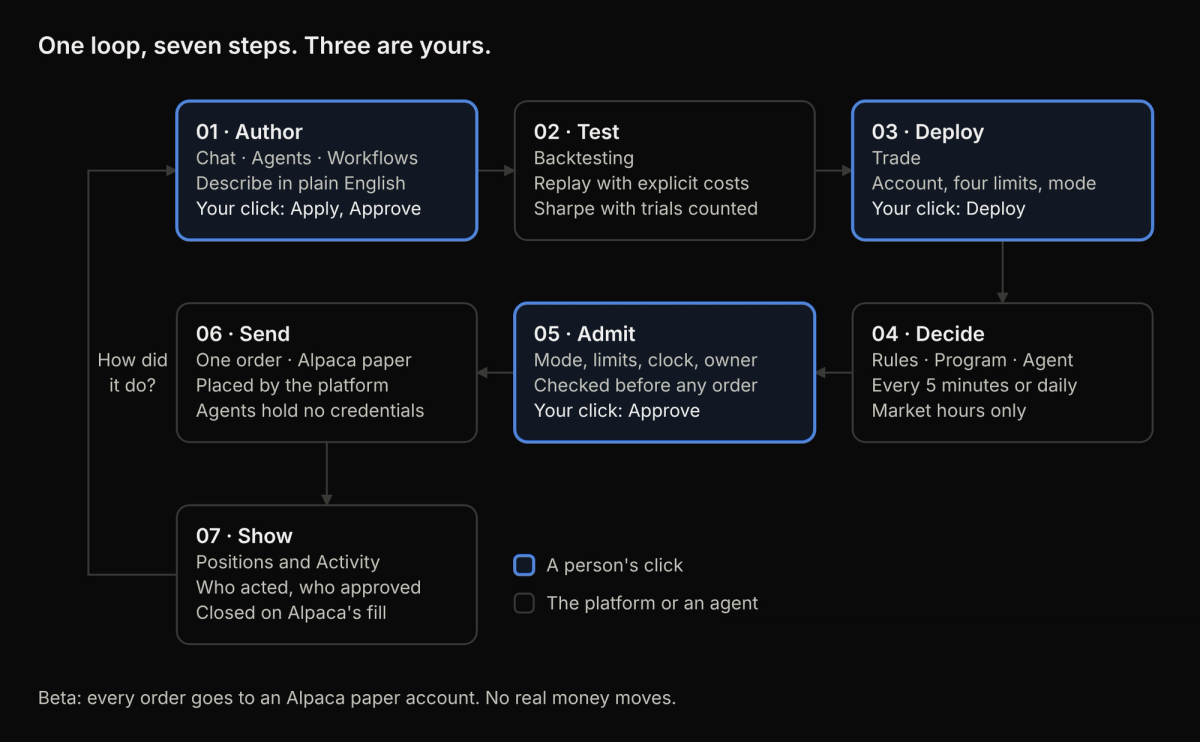
Orbital has five parts: Chat, Agents, Workflows, Backtesting, and Trade. Together they take an idea from a sentence to a filled order in seven steps. Three of those steps wait for you: accepting the strategy, deploying it, and approving its orders. Orbital handles the rest.
Chat
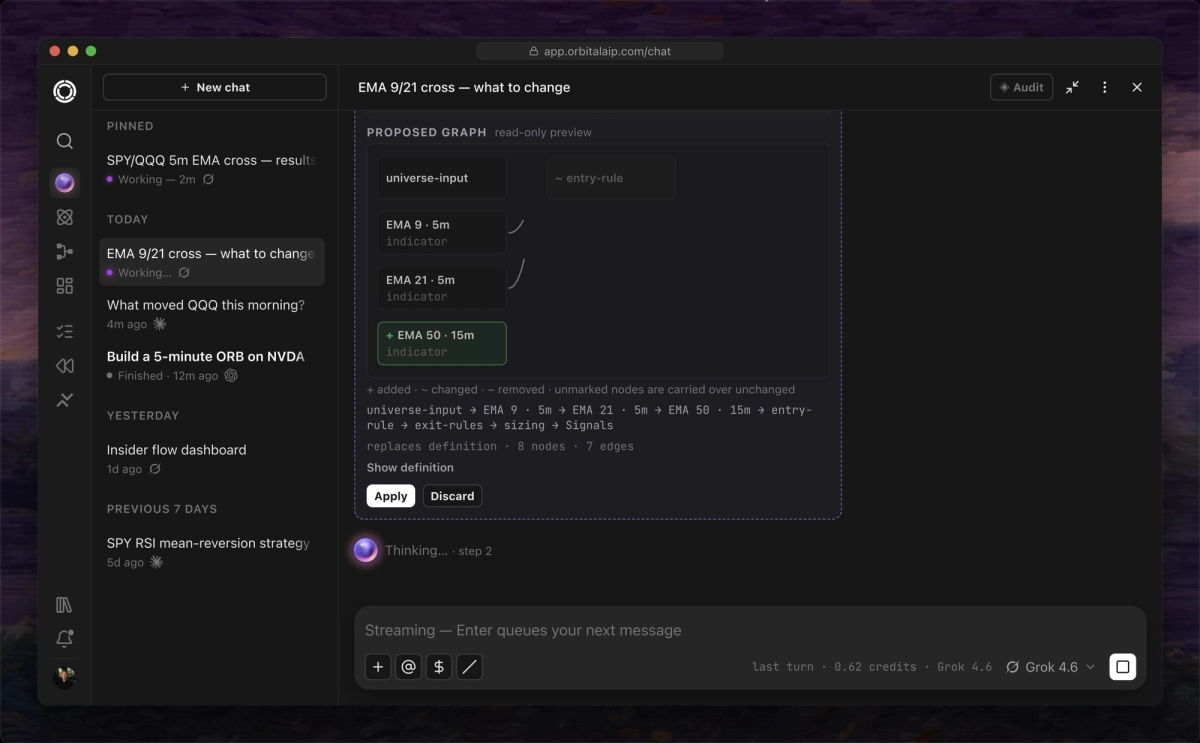
Ask about your workflows, backtests, and results in plain English. When Chat wants to change something, it proposes the change as a card, and nothing changes until you apply it. Every tool call it makes is shown as it ran, and you choose the model for each conversation.
Agents
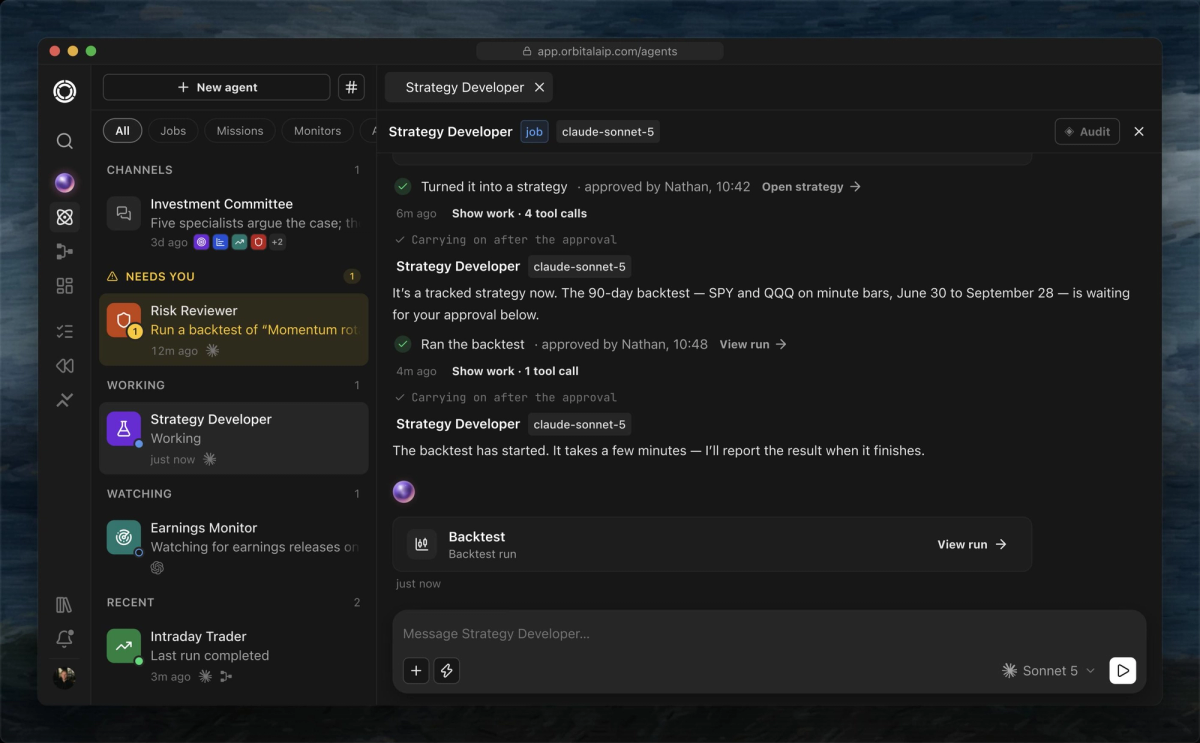
Agents work in the background: on a schedule, toward a goal, or when a signal fires. By default they ask before tracking a strategy or spending credits, and every run ends with a receipt. The beta ships with six, including an Investment Committee where five specialist agents argue the case and a chair makes the call.
Workflows
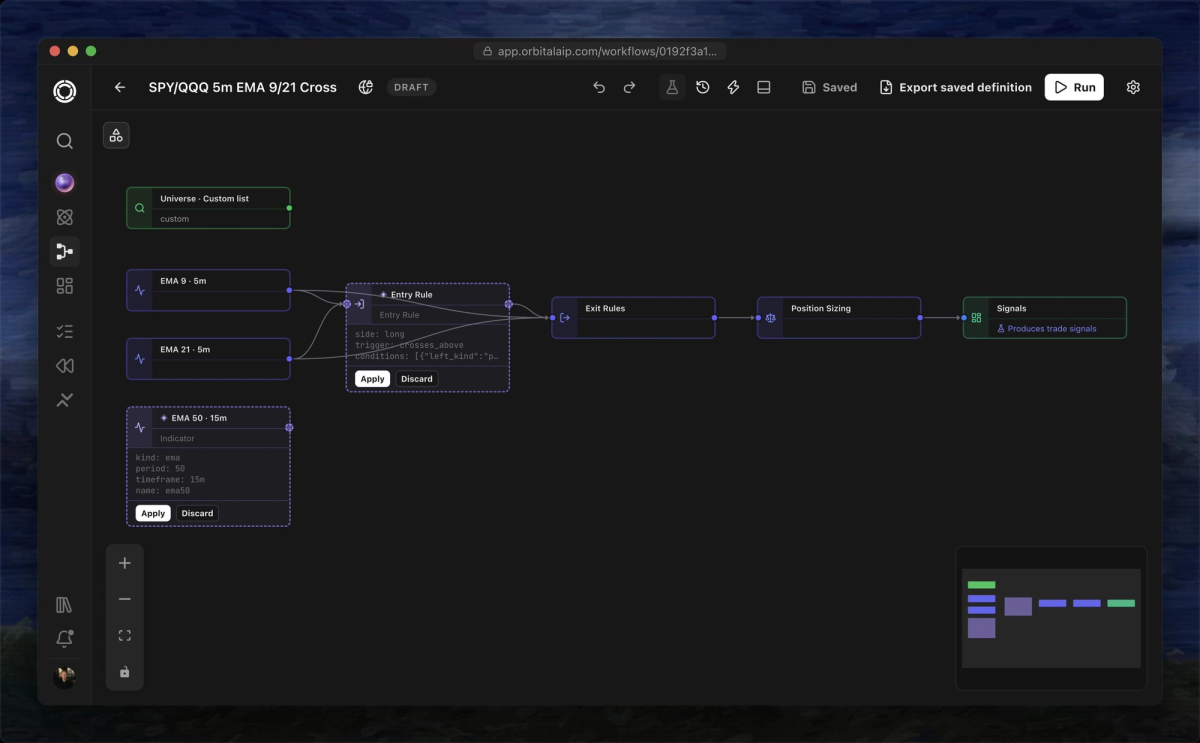
Every strategy is a workflow you can open and read: a universe, indicators, an entry, an exit, and a position size, each one a node. It can make its decisions with simple rules, code, or an agent's judgment. When an agent edits a strategy, the changes show up dashed on the canvas until you accept them.
Backtesting
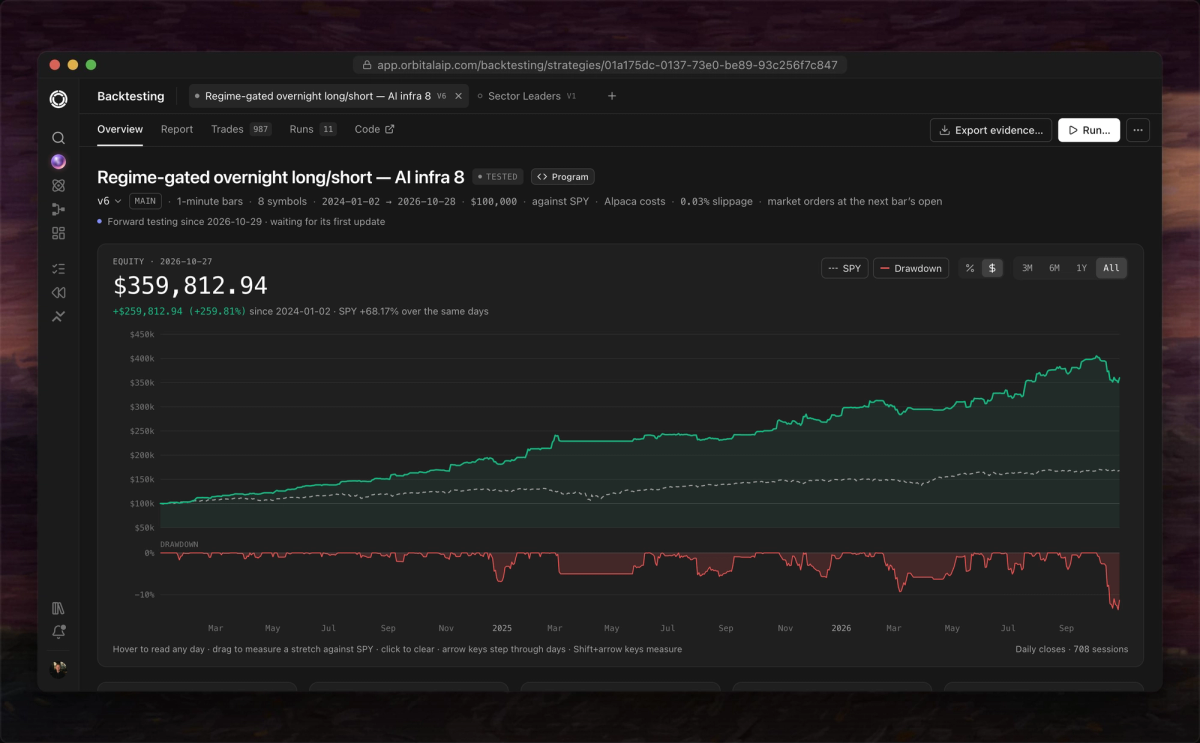
Orbital's own engine replays daily bars for every US stock since 2016 and minute bars since September 2023, with trading costs included. Rules fire at a bar's close and act at the next bar's open, so a test can't peek ahead, and the same test always produces the same result. Each report then asks how much of the return could be luck: it discounts the Sharpe ratio for every version you tried, runs 1,000 Monte Carlo resamples of your trades, and spells out what the sample is too small to tell you.
Trade
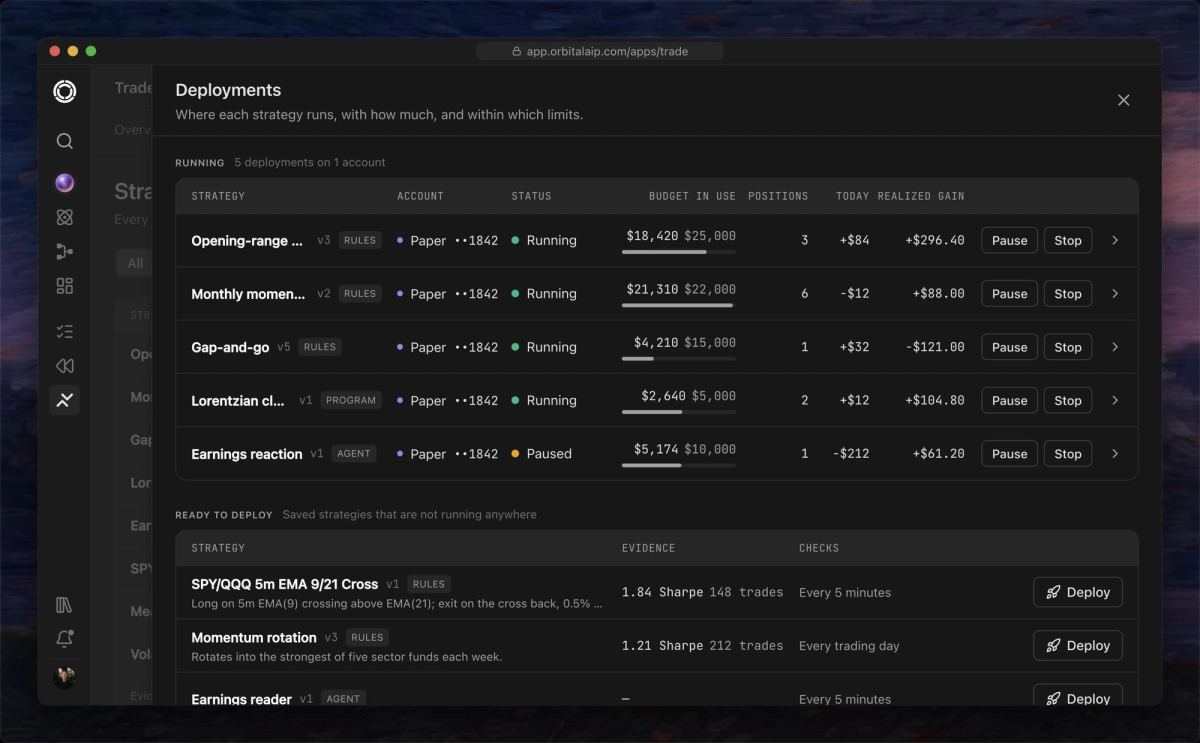
Trade runs your strategies on your Alpaca paper account and lays them out side by side, each with its evidence, budget, and results. Orders waiting on you sit in Activity, where you can approve, adjust, or refuse each one. You can also place orders by hand, and nothing shows as closed until Alpaca confirms the fill.
You stay in control
Agents don't hold your broker keys. An agent can decide to trade, but Orbital places the order, and only after checking it against that strategy's permissions and limits.
Each strategy runs in one of four permission modes. Ask is the default, and you can loosen it as a strategy's record earns your trust.
| Mode | New trades | Exits |
|---|---|---|
| Deny | Never placed | Never placed |
| Ask (default) | Wait for your approval | Wait for your approval |
| Auto | Wait for your approval | Placed, never held |
| Always-approve | Placed within limits, shorts included | Placed |
If an order waits on you for 24 hours, a new trade is dropped and an exit goes out anyway, so a strategy is never left holding a position because you were away.
Every strategy also has a budget, a cap per trade, a cap on open positions, and a daily loss limit that pauses new trades. And each account has one switch that stops everything: it pauses every strategy, cancels open orders, and closes positions.
A real strategy
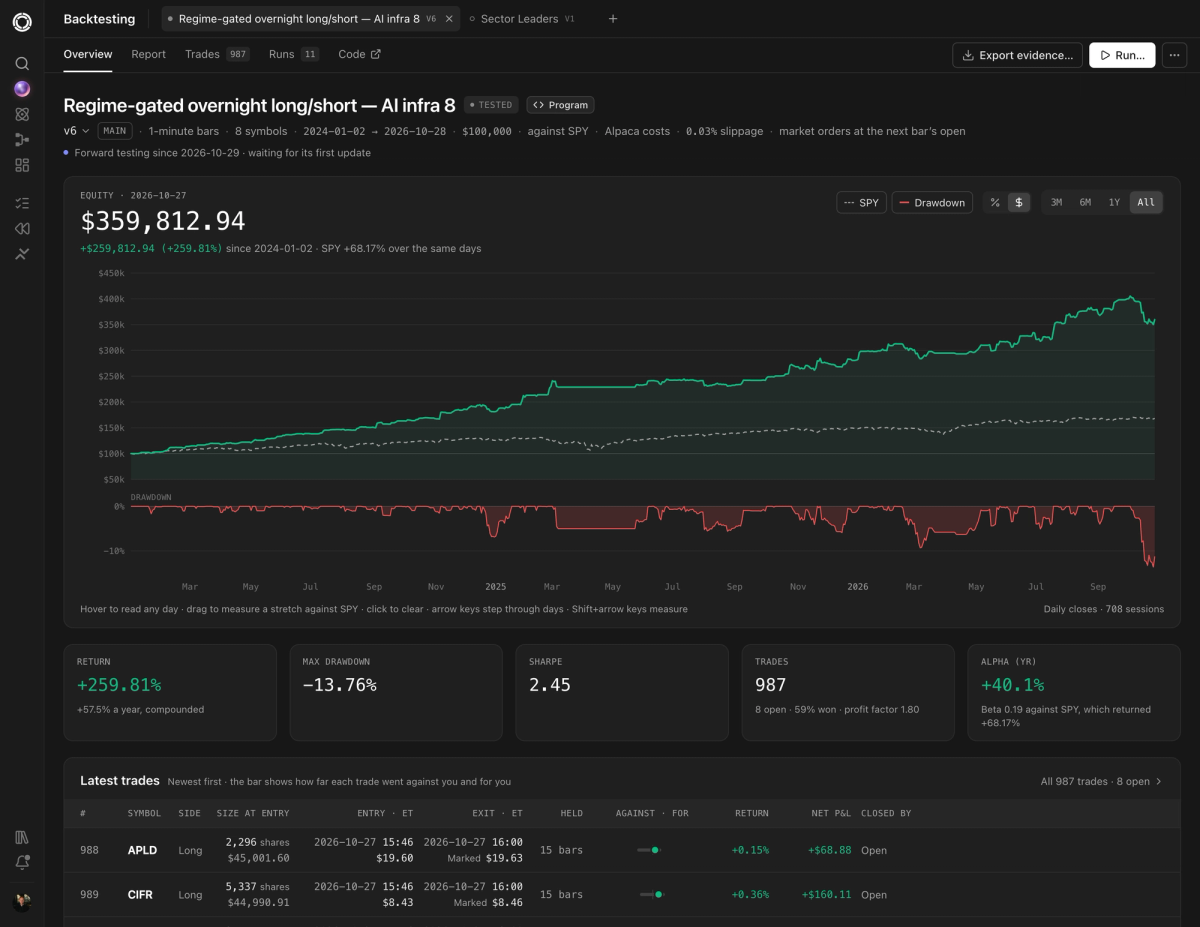
The Backtesting screenshot above is the most recent strategy from my own account: a regime-gated overnight long/short strategy on eight AI-infrastructure stocks, now on its sixth version.
The backtest replays January 2, 2024 to October 28, 2026 on 1-minute bars, 708 sessions in all, starting with $100,000, with Alpaca's costs, 0.03% slippage, and market orders filled at the next bar's open. It began forward testing on October 29, so from here on its results come from days the backtest never saw.
| Measure | Result |
|---|---|
| Return | +259.81% (+57.5% a year, compounded), against +68.17% for SPY over the same days |
| Max drawdown | -13.76% |
| Sharpe | 2.45 |
| Trades | 987 (8 still open), 59% won, profit factor 1.80 |
| Alpha vs SPY | +40.1% a year, beta 0.19 |
Numbers this strong need checking. It took six versions and eleven runs to get here, and the report discounts the Sharpe for that search. The deepest drawdown is also the most recent, at the very end of the test. And these are backtested results, not live trading.
Pricing and access
Every plan includes the full market data layer: prices and bars, fundamentals, news, analyst ratings, earnings, insider and congressional trades, and Stocktwits sentiment. Credits pay for AI usage only; backtests don't use any.
| Plan | Price | AI created per month | Models |
|---|---|---|---|
| Free | $0 | 100 | Cost-efficient OpenAI and Claude models |
| Pro | $30 | 3,000 ($30 of AI usage) | Any model, frontier included |
| Max | $100 | 10,000 ($100 of AI usage) | Any model, frontier included; bring your own keys at cost |
This is beta pricing, and plans may change before general availability. To get started:
- Sign up at app.orbitalaip.com.
- Connect an Alpaca paper account.
- Describe a strategy, review the backtest, and deploy it with limits you're comfortable with.
Questions go to the Orbital Discord until the docs ship. Teams, press, and partners can reach us at hello@orbitalaip.com.
Limitations
- No real money moves during the beta. Every order goes to an Alpaca paper account.
- Market data may be delayed, and minute bars only go back to September 2023, regular trading hours only.
- A good backtest can still mislead. The strategy above took six versions to find, and its deepest drawdown is its most recent.
- Agents make mistakes, which is why they ask first by default.
Why I built Orbital AI
I had strategy ideas I could describe in a sentence and no quick way to turn them into something I could read, test against real data, and run inside limits. Each one meant a week of code. The tools that promised to skip that step either hid the strategy inside a model or hid the costs inside a backtest nobody could reproduce.
I've spent thirteen years building Udundi, an e-commerce agency I started in college, and I built Compose, an A/B testing platform for Shopify. Both taught me the same thing: a process you can write down is a process you can improve. Orbital applies that to trading.
Orbital is a solo project. I build it with coding agents, and I test my own ideas on it, like the strategy above.
If you try Orbital and it does something you wouldn't have done, tell me in the Discord, on X, or on Stocktwits.
Nathan Parker,
Founder of Orbital AI, Inc.