The artificial intelligence infrastructure buildout has been the dominant investment theme of 2023-2025. Investors poured capital into GPU manufacturers, cloud hyperscalers, and foundational model developers. But as this initial wave matures and valuations stretch, a critical question emerges: What's the next layer of the AI investment stack?
I believe the answer lies in agentic AI orchestration—and UiPath (NYSE: PATH) stands uniquely positioned to capture this emerging opportunity. Trading at $14.52 with a technical setup pointing toward $28, PATH represents one of the most asymmetric risk/reward profiles in enterprise software today.
The Investment Thesis: Why Now, Why PATH?
UiPath isn't just another automation company trying to rebrand for the AI era. It's the global leader in robotic process automation (RPA) with 35.8% market share, serving over 10,820 customers including 320 generating more than $1 million in annual recurring revenue. The company just achieved its first GAAP profitable quarter, holds $1.5 billion in cash with zero debt, and is executing a strategic pivot that could redefine enterprise AI implementation.
But here's what makes this opportunity compelling right now:
The market has priced PATH as a declining RPA vendor when it's actually positioned to become the orchestration layer for the entire enterprise AI stack.
Think about where we are in the AI adoption cycle. Companies have spent billions on AI infrastructure—GPU clusters, model licenses, vector databases. Now they face the "last mile problem": how do you actually make these AI capabilities work within complex, multi-system enterprise environments? How do you ensure governance, auditability, and reliability when AI agents make decisions that impact revenue, compliance, and customer experience?
This is precisely the problem UiPath's agentic automation platform solves.
The Technical Setup: A Textbook Accumulation Pattern
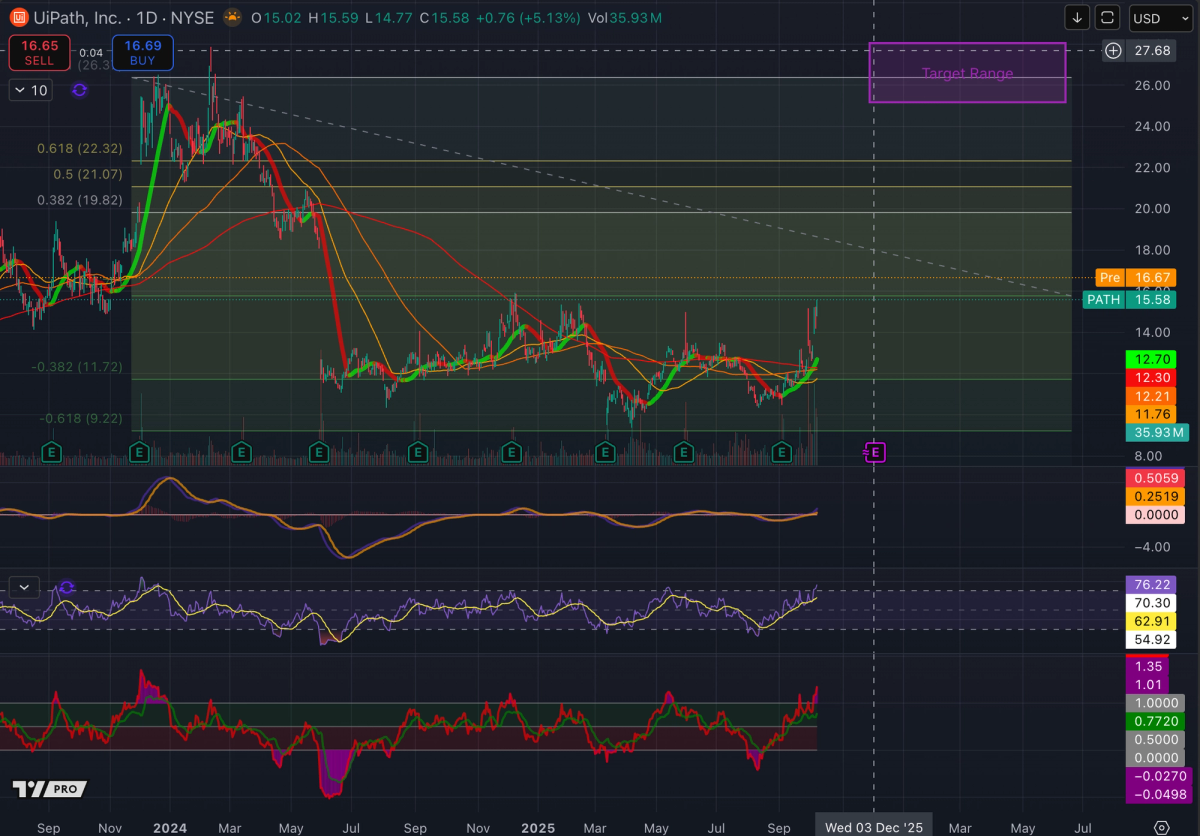
Let's start with what the charts are telling us—because technical analysis and fundamentals are converging in a way that rarely occurs.
The Multi-Year Base is Complete
PATH has spent over three years building one of the most compelling accumulation patterns I've seen in enterprise software. After declining 84% from its $90 post-IPO peak to a low of $9.38, the stock has formed a classic Stage 1 base—the type of technical formation that precedes major bull runs.
Here's the setup:
1. Golden Cross Confirmed
The 50-day moving average ($12.80) has crossed above the 200-day MA ($12.50) on expanding volume. This is one of the most reliable bullish signals in technical analysis, particularly when it occurs after an extended consolidation period.
2. Volume Profile Shows Accumulation
Recent trading volume surged to 4.1x the daily average on upward price movements. This isn't retail FOMO—this is institutional accumulation. When you see 56-59 million shares trading (versus a 14.35 million average) on positive catalysts, smart money is positioning.
3. Breakout from Bollinger Bands
The stock has broken above the upper Bollinger Band at $13.15 with the bands expanding—a textbook breakout signal that suggests the beginning of a trending move rather than a mean-reversion setup.
4. RSI Shows Strength Without Excess
At 42-67 (depending on timeframe), the Relative Strength Index is in the sweet spot. It's showing momentum without being overbought, meaning there's substantial room to run before hitting the typical 70+ overbought threshold.
The Path to $28: A Multi-Stage Rally
Here's how I see the technical roadmap unfolding:
Stage 1: Break Through $15.93 (52-Week High)
- Target: $15.93
- Catalyst: Q3 earnings beat (December 3-4)
- Probability: 70%
- This level represents the first major resistance and the 52-week high
Stage 2: Clear the $18 Psychological Level
- Target: $18.00
- Catalyst: Analyst upgrades following execution proof
- Probability: 60%
- Multiple analysts have $18 as their bull case target
Stage 3: Retest Pre-Decline Levels at $22
- Target: $22.00
- Catalyst: Material agentic AI revenue recognition (FY2027)
- Probability: 50%
- This aligns with DCF intrinsic value estimates
Stage 4: Full Re-Rating to $28
- Target: $28.00
- Catalyst: Proof of agentic AI platform leadership + re-acceleration to 20%+ growth
- Probability: 40%
- This represents the bull case scenario where PATH becomes the de facto enterprise AI orchestration standard
The Short Squeeze Multiplier
Here's an additional technical catalyst few are discussing: short interest sits at 12.53% of the float—significantly elevated for an enterprise software stock. With days-to-cover dropping below 1 day given recent volume, any sustained move above $16 could trigger a short squeeze that accelerates the rally toward our $28 target.
The options market is already positioning for this move. The put/call ratio of 0.47 shows heavy bullish positioning, and we're seeing unusual call volume in January 2027 contracts—smart money betting on a multi-year re-rating.
Why Agentic AI is the Next Investment Wave
To understand why PATH could deliver 90%+ upside from current levels, you need to understand the secular shift happening in enterprise AI adoption.
The Infrastructure Play is Saturating
The AI infrastructure trade has been extraordinary. NVIDIA is up 200%+ since early 2023. Cloud providers have captured hundreds of billions in market cap. But this phase is maturing. GPU supply is normalizing. Model training costs are declining. The incremental dollar of infrastructure spending produces diminishing returns.
The next phase—the application layer—is just beginning.
And within the application layer, the highest-value opportunity isn't consumer chatbots or coding assistants. It's enterprise agentic automation—AI systems that can autonomously execute complex, multi-step business processes with governance and reliability.
The $75+ Billion Opportunity
The numbers tell the story:
- Traditional RPA market: $6.3B (2024) → $30.9B (2030) at 43.9% CAGR
- Intelligent Automation TAM: $15-20B → $75B+ by 2030
- Agentic AI TAM: Emerging, potentially $100B+ as enterprises adopt AI agents
UiPath currently commands 35.8% of the RPA market with $1.72 billion in ARR. If it captures even 15-20% of the broader intelligent automation and agentic AI market, you're looking at a $11-15 billion ARR company by 2030—implying a current valuation that's 50-70% below fair value.
Why UiPath Wins the Agentic AI Platform War
Multiple companies will compete in agentic AI, but UiPath has several structural advantages:
1. The "Switzerland of Agents" Positioning
UiPath has strategically positioned as vendor-agnostic, integrating with OpenAI, Google Gemini, Anthropic's Claude, NVIDIA's NIM, and Microsoft Copilot. This neutrality is exactly what enterprise IT wants—they don't want another vendor lock-in. They want an orchestration layer that works across their heterogeneous tech stack.
2. Embedded in Mission-Critical Workflows
With 10,820 customers already running thousands of automations on UiPath's platform, the switching costs are prohibitive. The company's 108% dollar-based net retention rate proves this—customers don't just stay, they expand spending. This installed base becomes the beachhead for agentic AI adoption.
3. Enterprise-Grade Governance from Day One
Consumer AI tools prioritize capability over control. Enterprise AI requires the opposite. UiPath's platform was built for regulated industries (banking, healthcare, government) with audit trails, role-based access control, and deterministic reliability. These capabilities become more valuable, not less, as AI agents gain autonomy.
4. The Partnership Flywheel
The September 2025 partnership announcements weren't marketing—they were strategic. By integrating with NVIDIA (high-trust microservices for regulated industries), OpenAI (frontier models), Google Cloud (Gemini-powered voice agents), and Snowflake (data-to-action automation), UiPath is weaving itself into the fabric of enterprise AI infrastructure.
When Deloitte builds "Agentic Global Business Services" on the UiPath platform, when Cognizant leverages UiPath Maestro for intelligent claims processing, when HCLTech forms a strategic partnership—these aren't one-off deals. They're ecosystem validation that creates a self-reinforcing moat.
The Bull Case to $28: Scenario Analysis
Let me lay out the bull case as I see it unfolding over the next 6-18 months:
Near-Term (Q3-Q4 FY2026): Execution Proof
- Q3 earnings (Dec 2025) continue the "beat and raise" pattern
- Revenue growth reaccelerates to 12-15% as federal sector normalizes
- Non-GAAP operating margin expands to 18-20%
- Customer metrics show 500+ actively developing agents (from 450)
- Stock moves to $18 on de-risked execution → +24% from current
Medium-Term (FY2027): Agentic Monetization
- Agentic AI products begin material revenue contribution (Q2-Q3 FY27)
- ARR growth reaccelerates to 15-18% as AI platform scales
- Operating leverage drives non-GAAP margins to 22-25%
- Dollar-based net retention climbs back to 115-120%
- Analyst upgrades cascade as growth narrative shifts
- Stock reaches $24 on revenue re-acceleration → +65% from current
Long-Term (FY2028+): Platform Leadership
- UiPath establishes itself as the enterprise standard for AI orchestration
- ARR reaches $2.5-3.0 billion on 20%+ sustained growth
- The company generates $600-700M in operating income
- Market applies a 7-8x EV/Sales multiple (versus current 3.6x)
- Stock achieves $28+ as platform dominance is priced in → +93% from current
The Math Behind $28
Here's the valuation framework supporting a $28 price target:
Conservative Path (P/S Multiple Expansion):
- FY2027 Revenue: $1.85 billion (11% CAGR from current)
- Target P/S Multiple: 7.5x (still below ServiceNow at 14.5x)
- Enterprise Value: $13.9 billion
- Less Net Cash: $1.5 billion
- Implied Market Cap: $15.4 billion
- Shares Outstanding: 530 million
- Price Target: $29.00
DCF-Based Path:
- Current DCF intrinsic value: $17.79 (per Simply Wall St analysis)
- With agentic AI success, adjusted for:
- Revenue growth acceleration: +20% to base case
- Margin expansion: +500bps to operating margin
- Lower discount rate: -100bps on de-risked execution
- Updated Intrinsic Value: $26-28
Peer Multiple Path:
- UiPath at 5.5x P/S vs. peer average 9.1x P/S
- Close 40% of the gap as AI strategy de-risks: 7.0x P/S
- Apply to current TTM revenue: $1.5B × 7.0 = $10.5B EV
- Add net cash: $1.5B
- Market cap: $12.0B ÷ 530M shares
- Price Target: $22.64
All three methodologies converge in the $22-29 range, with $28 representing a reasonable bull case midpoint.
The Catalyst Timeline: What to Watch
For this thesis to play out, we need to see specific proof points. Here's what I'm monitoring:
December 2025: Q3 Earnings (Critical Inflection)
- What We Need to See:
- Revenue growth of 12-14% (reacceleration from 11%)
- ARR addition of $40-50M (versus $31M in Q2)
- Customer count growth resuming (currently flat)
- Specific customer wins with agentic products
- Raised guidance for Q4 and FY2027
- Why It Matters: This will be the first test of whether the agentic AI pivot is gaining commercial traction beyond pilot programs.
Q1-Q2 FY2027: Monetization Evidence
- What We Need to See:
- First material contribution from agentic products to ARR
- Success stories of customers moving from pilot to production
- 600-800 customers actively building agents
- Net retention stabilizing above 110%
- Why It Matters: This is when management has guided that agentic AI will begin materially impacting financials.
Ongoing: Partnership Development
- What We Need to See:
- Joint customer wins announced with NVIDIA, OpenAI, Google
- GSI (Deloitte, Cognizant, HCL) packaged solutions launching
- Integration depth increasing (not just API connections)
- Why It Matters: Partnerships are only valuable if they drive revenue. We need to see them translate to commercial outcomes.
Risk Factors: The Bear Case Alternative
Intellectual honesty requires acknowledging where this thesis could be wrong:
Risk #1: Microsoft Commoditizes the Market
The Threat: Microsoft aggressively bundles Power Automate with Office 365 and integrates it deeply with Copilot at effectively zero marginal cost. Enterprises choose "good enough" over "best in class" to avoid another vendor relationship.
Mitigation: UiPath's neutrality and superior enterprise capabilities (governance, auditability, multi-system orchestration) create value Microsoft's integrated approach cannot match. Early evidence suggests they're more partners than competitors.
Bear Case Impact: If this materializes, stock could trade down to $9-10 (bear case from research), representing 30-35% downside.
Risk #2: Agentic AI Adoption Slower Than Expected
The Threat: Enterprises remain in pilot purgatory. Concerns about AI reliability, hallucinations, and compliance slow production deployments. The gap from 450 customers developing agents to meaningful revenue proves longer than FY2027.
Mitigation: UiPath's deterministic RPA foundation combined with AI creates a "training wheels" approach that reduces adoption risk. The 108% net retention proves customers find value.
Bear Case Impact: Delays monetization 12-18 months, keeps stock range-bound at $12-16.
Risk #3: Execution Missteps
The Threat: Go-to-market execution falters. Key talent departs. Product integration issues arise. The company that spent 2023-2024 restructuring stumbles during the critical FY2027 ramp.
Mitigation: Recent operational improvements (17% operating margin from 2%, consecutive beats) suggest execution has stabilized. CEO Daniel Dines' return and $1.5B ownership stake align incentives.
Bear Case Impact: Would likely trigger my stop loss at $12.50, limiting downside to 14%.
The Asymmetric Profile
Even accounting for these risks, the setup is asymmetric:
- Upside to Bull Case ($28): +93% from $14.52
- Downside to Bear Case ($9): -38% from $14.52
- Probability-Weighted Expected Return:
- Bull Case (40%): +37.2%
- Base Case (35%): +3.4% (to $15)
- Bear Case (25%): -9.5%
- Expected Value: +31.1%
That's a favorable risk/reward for a speculative growth position.
Positioning for the Trade
Here's how I'm thinking about position sizing and risk management:
Entry Strategy
- Primary Entry: Current levels ($14-16)
- Add on Weakness: $12.50-13.50 if we get a pullback
- Avoid Chasing: Above $18 without a consolidation
Position Sizing
- Aggressive Growth Portfolio: 5-7% position
- Balanced Portfolio: 3-5% position
- Conservative Portfolio: 1-2% or avoid until more proof
Risk Management
- Stop Loss: $12.50 (below the key support and breakout level)
- Take Profit Ladder:
- 25% at $18 (24% gain, lock in first technical target)
- 25% at $22 (51% gain, DCF fair value)
- 50% at $28+ (93% gain, bull case target)
Time Horizon
- Minimum: 12 months (for Q3 earnings to play out)
- Target: 18-24 months (for FY2027 monetization evidence)
- Maximum: 36 months (for full platform leadership thesis)
This is not a quick trade. It's a multi-quarter position thesis that requires patience and conviction through volatility.
The Orbital AI Perspective: Why This Matters
At Orbital AI, we focus on identifying inflection points in the technology adoption curve—moments when underappreciated shifts in enterprise behavior create mispricings in public markets. UiPath represents exactly this type of opportunity.
The market is still pricing PATH as a mature RPA vendor in a commoditizing market, trading at 5.5x P/S versus software peer averages of 9.1x. But the company is actually positioned at the intersection of three major trends:
- The shift from AI experimentation to AI production (enterprises moving from pilot to scale)
- The evolution from point solutions to orchestration platforms (the "operating system" for AI agents)
- The transition from infrastructure to application layer (where value capture moves in AI investing)
When these trends converge—and I believe we're 6-12 months from that inflection—UiPath's valuation should re-rate dramatically.
The technical setup suggests institutions are already positioning for this. The volume accumulation, the golden cross, the options positioning—these are not retail investors speculating on a meme stock. This is smart money building positions ahead of a catalyst.
Conclusion: The Next Chapter in Enterprise AI
The AI infrastructure build-out created historic wealth. NVIDIA, Microsoft, Google, AWS—all captured extraordinary value. But that phase is maturing.
The next wave—the application layer, the orchestration layer, the "last mile" of enterprise AI—is just beginning. And the companies that solve the governance, reliability, and integration challenges of agentic AI will capture outsized value over the next 3-5 years.
UiPath stands at this inflection point. With $1.5 billion in cash, zero debt, a fortress balance sheet, and 35.8% market share in its core market, it has the resources and positioning to lead. The recent partnerships with OpenAI, NVIDIA, Google, and Snowflake aren't marketing fluff—they're strategic positioning for the platform war to come.
At $14.52, with a technical setup pointing to $28 and a fundamental thesis supporting that target, PATH represents one of the most compelling asymmetric opportunities in enterprise software today.
The infrastructure wave minted fortunes. The agentic AI wave will mint the next generation. And I believe UiPath will be one of its primary beneficiaries.
Disclaimer: This analysis represents my personal views and is not investment advice. I may hold a position in PATH. Always conduct your own due diligence and consult with a financial advisor before making investment decisions.
For more deep-dive analysis on AI investing and enterprise technology trends, follow the Orbital AI Blog.